Get Out in Nature and Forage!
Article & Photos by: Dr. Jane Choi-Doan, Associate Professor Environmental Studies/Life Sciences at Hagerstown Community College
Foraging mainly involves collecting edible plant parts outdoors, for free! But, before you start, there are some things to consider! Make sure you have permission from the landowner if it is on private property. In state parks, you generally cannot remove anything. (In MD, “an individual may not remove, disturb, damage, or destroy a plant, rock, mineral, or animal without a permit.”) In the tristate area you can forage for plant-parts, such as berries, fruits and mushrooms only for personal use. Digging is prohibited – no full plants or removal of roots, although many places are making exceptions for certain invasive species. Please check the rules with each park you plan to visit.
There are many wonderful plants, even in your yard that you can add into your salad – dandelions, violets, lamb’s quarters (wild spinach), chickweed, plantain, lady’s thumb, and garlic mustard. If you are serious about foraging, there are some wonderful guides out there (I highly recommend Northeast Foraging by Leda Meredith), as well as online resources. Make sure you are 100% positive on any ID before eating anything out in the wild!
Another word of caution – make sure you are foraging in areas that have not been sprayed with pesticides, or located near busy roads that may be exposed to pollutants. I highly encourage folks to forage in their own yards and limit the use of insecticides and other chemicals. Let your lawn be filled in with flowering “weeds” such as dandelions and violets that will benefit pollinators, such as bees. Did you know we have more than 400 different species of bees in Maryland alone? Many of our bees are having a hard time finding enough food/nectar, and are being killed off by chemicals that are sprayed in lawncare. Experts believe we may be in a “bee apocalypse.”
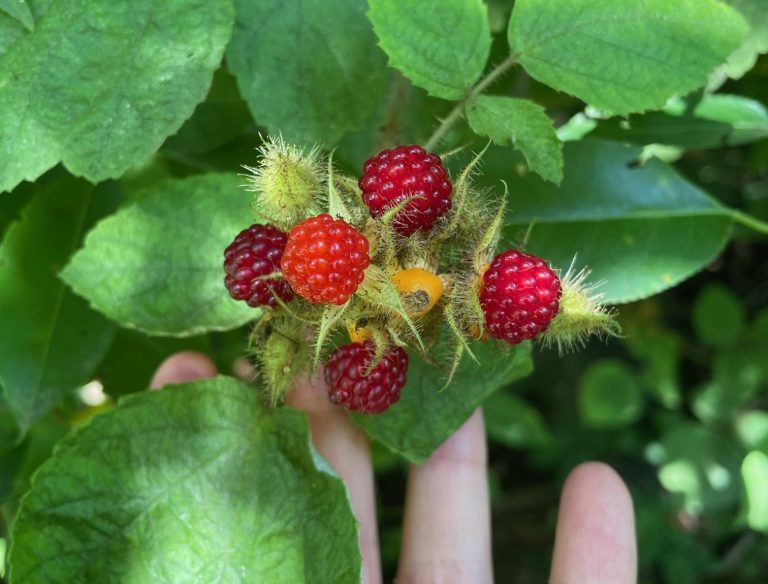
Some of my favorite edible plants, with no poisonous look-alikes, are blackberries, raspberries, mulberries and pawpaws. In the tri-state area, any compound/aggregate fruit or “brambleberries” are safe in the early summer! Native blackberries are also called “dewberries” and are dark purple when ripe. Black raspberries are hollow like raspberries, but please be careful with thorns – I recommend long sleeves and pants while picking. The most abundant, widespread and delicious red raspberry is the invasive wineberry. Instead of thorns they have hairy bristles and the berries are much more delicate when collecting. Unlike blackberries and raspberries, mulberries grow on trees and ripen in late spring. In our region we have native red, as well as non-native white and black mulberries. If the trees are tall, I recommend getting a clean tarp to lay down below the branches and gently shaking the lower branches. The ripe berries will rain down on the tarp.
My most favorite foraged fruit is the pawpaw – the largest edible fruit tree native to North America. It is custard-like banana with a hint of mango. Make sure the fruit is very ripe before eating – look for the fallen fruit on the ground around mid-September, and watch out for the large seeds!
Hopefully reading this gets you motivated to forage! Remember, safety first, and always dress for the weather. Bring a hat, sunscreen, and sturdy shoes, as terrain can be uneven. Protect yourself from mosquitoes/biting insects and make sure to check for ticks. When hiking and foraging in the woods, I suggest going with a friend. Again, before collecting, make sure you are 100% positive on the ID. I highly recommend downloading the free iNaturalist or Seek App to help identify not only plants, but also animals you might find while you are out foraging. Furthermore, there are many social media foraging groups and ID groups that are excellent to triple check what you forage.
Finally, I implore everyone to practice sustainable foraging by remembering the “Rule of thirds” – save one third for animals, one third for ecosystem health, and collect one third for your own use. If you do collect sensitive species like ramps, make sure you only take a leaf and leave the plant behind. Keep a journal or pin the location in your personal Google maps so you can come back to the same location every year! Remember, if overharvested or uprooted, there will be no more in the future. Likewise, please be mindful of what plants and flowers are nearby – don’t trample them in your excitement!
Want to see more of Tristate Outdoor 2024 Magazine?
More Articles


Smithsburg Steam and Craft Show Gears Up for Another Big Year